VOGUE | The exhibition "Black Thread" explores luxury, sustainability and political consumption in the context of African fashion
Scroll down for the German version
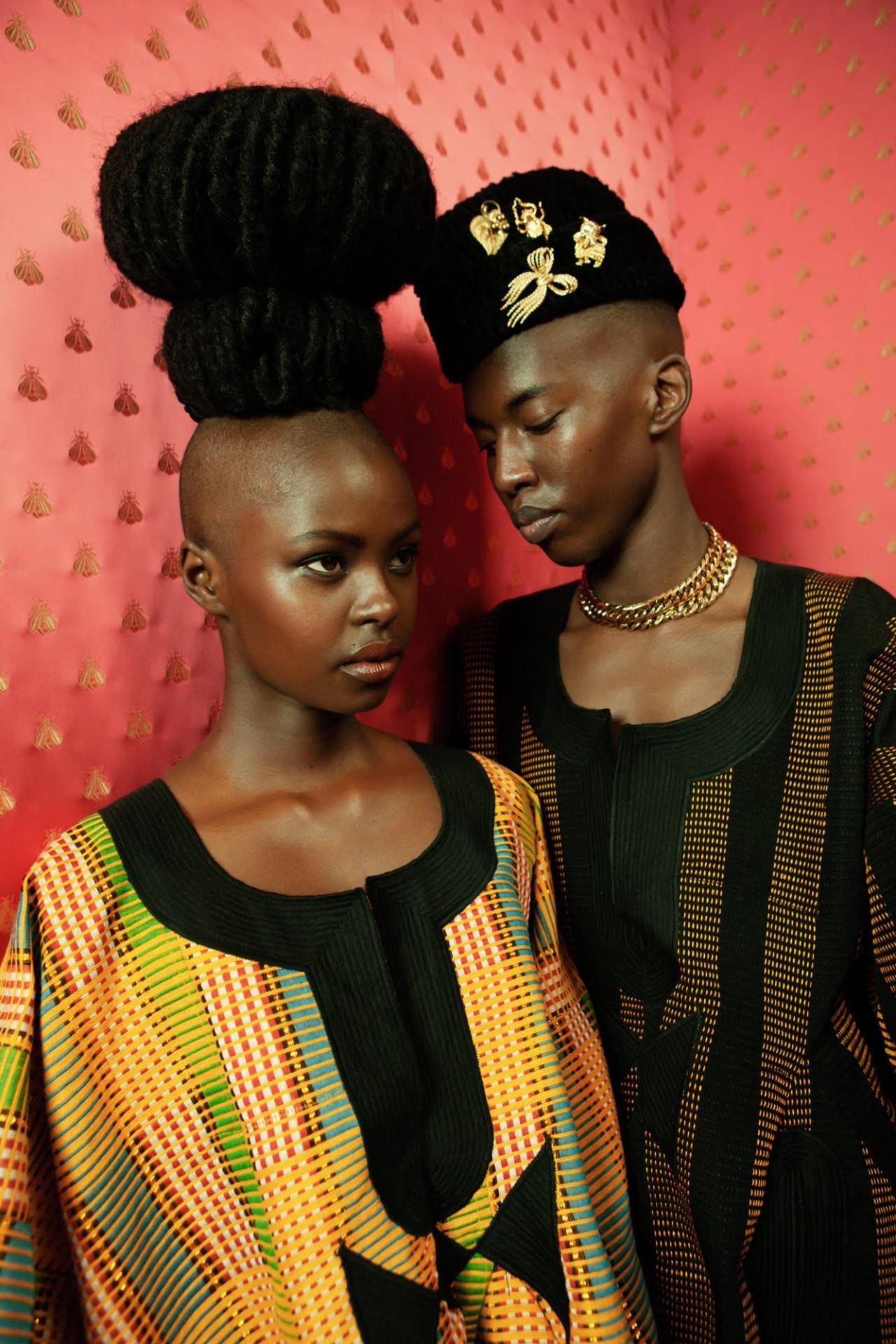
"Black Thread" is a collaborative project between the Paris-based designers Imane Ayissi and Amah Ayivi (Marché Noir), as well as the cultural platforms Art Comes First, Just Africa, Institut Français in Sweden and the Gothenburg Museum for World Culture. The exhibition connects West African craftsmanship with vintage, fast fashion, and haute couture.
When people talk about West African fashion, colorful wax prints with playful patterns often come to mind. The fact that these fabrics are largely produced in the Netherlands and China, and that their dominance threatens the local textile industry is often unknown in the Global North. The exhibition "Black Thread" challenges ideas of what "typically African" fashion looks like, as the weaving technique, colour selection and dyeing methods of traditional fabrics express social belonging and status. Alongside designs of the Paris-based labels Imane Ayissi and Marché Noir, "Black Thread" showcases objects from the collection of the Gothenburg Museum for World Culture, and films produced by the London-based cultural platform Art Comes First, which co-curated the exhibition.
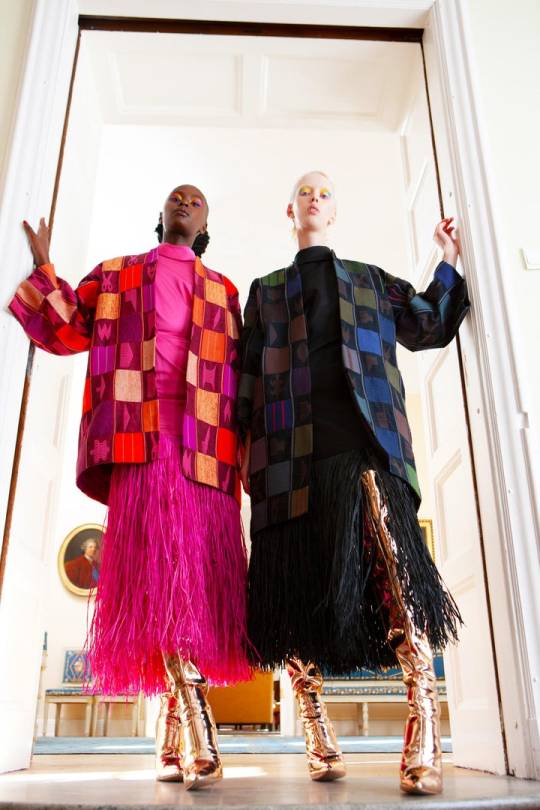
When Imane Ayissi presented his debut collection at Haute Couture Week in Paris this January, he caused a stir, as he was only the third African designer to receive this honor. Ayissi is known for incorporating West African craftsmanship into his designs and works with fabrics such as Ghanaian kente, Malian bògòlanfini, Faso dan Fani from Burkina Faso, Raffia from Madagascar, Obom (fabric made from wood bark), and Ndop (indigo-colored batik fabric) from Cameroon.
For both Imane Ayissi and Amah Ayivi, the founder of Marché Noir, it goes without saying that fashion must also be sustainable. Marché Noir combines West African craftsmanship (i.e elaborately produced Ghanaian batakalis) with vintage finds from Lomé, where Ayivi spent his childhood. For Ayivi, reclaiming second-hand clothes from the Global North and showcasing them at Paris Fashion Week is a "militant act".
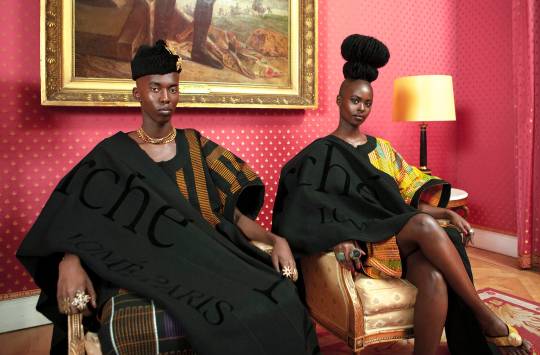
While awareness for sustainable, high-quality fashion is increasing in the Global North, tons of fast fashion from the USA, Europe and China is still shipped to African countries on a weekly basis. Not only does this harm local fashion industries, it also pollutes the environment due to the poor quality of the fabrics. What both designers agree on is that awareness for sustainable, political consumption must also increase in African countries in order for traditional crafting techniques to survive. Or, as Imane Ayissi put it: "When people forget their traditional fabrics, they also forget their culture".
All quotes were taken from the panel discussion "Creativity, sustainability and African textile stories" with Amah Ayivi, Imane Ayissi, Nana Sacko and Michael Barrett, moderated by Arieta Mujay in the Gothenburg Museum for World Culture on October 10, 2020.
German version
"Black Thread" is a collaborative project between the Paris-based designers Imane Ayissi and Amah Ayivi (Marché Noir), as well as the cultural platforms Art Comes First, Just Africa, Institut Français in Sweden and the Gothenburg Museum for World Culture. The exhibition connects West African craftsmanship with vintage, fast fashion, and haute couture.
When people talk about West African fashion, colorful wax prints with playful patterns often come to mind. The fact that these fabrics are largely produced in the Netherlands and China, and that their dominance threatens the local textile industry is often unknown in the Global North. The exhibition "Black Thread" challenges ideas of what "typically African" fashion looks like, as the weaving technique, colour selection and dyeing methods of traditional fabrics express social belonging and status. Alongside designs of the Paris-based labels Imane Ayissi and Marché Noir, "Black Thread" showcases objects from the collection of the Gothenburg Museum for World Culture, and films produced by the London-based cultural platform Art Comes First, which co-curated the exhibition.
Als Imane Ayissi im Januar 2020 bei der Haute Couture Week in Paris debütierte, machte er internationale Schlagzeilen, denn er war erst der dritte afrikanische Designer, dem diese Ehre zuteil wurde. Ayissi ist dafür bekannt, in seine Designs westafrikanische Handwerkskunst einfließen zu lassen. Er verarbeitet in seinen Kollektionen neben ghanaischem Kente, einem aufwändig gewebten Stoff, der früher ausschließlich Königen vorbehalten war, auch malisches Bògòlanfini (Stoff, der mit Pflanzenfarbe natürlich gefärbt wird), Faso dan Fani aus Burkina Faso, Raffia aus Madagaskar sowie Obom (ein Stoff aus Holzrinde) und Ndop (indigofarbener Batikstoff) aus Kamerun.
Sowohl für Imane Ayissi als auch Amah Ayivi, dem Gründer von Marché Noir, ist es selbstverständlich, dass Mode auch nachhaltig sein muss. Marché Noir kombiniert westafrikanische Handwerkskunst (z.B. in Form von aufwändig hergestellten ghanaischen Batakalis) mit Vintage-Fundstücken aus Lomé, wo Amah Ayivi seine Kindheit verbracht hat. Amah Ayivi bringt die Second-Hand-Kleidungsstücke zurück in den Globalen Norden und bezeichnet es als einen "militanten Akt", damit an der Pariser Fashion Week teilzunehmen.
Während im Globalen Norden das Bewusstsein für nachhaltige, qualitativ hochwertige Mode steigt, wird weiterhin tonnenweise Fast Fashion aus den USA, Europa und China in afrikanische Länder gebracht und dort günstig verkauft. Die Masse an Kleidung schadet nicht nur lokalen Modeindustrien, sondern belastet aufgrund der oft schlechten Qualität der Stoffe auch die Umwelt. Worin sich beide Designer einig sind, ist, dass das Bewusstsein für nachhaltigen, politischen Konsum auch in afrikanischen Ländern steigen muss, damit traditionelle Handwerkstechniken weiterhin am Leben bleiben – oder, wie Imane Ayissi es formuliert: "Wenn Menschen ihre traditionellen Stoffe vergessen, vergessen sie auch ihre Kultur."
Die Zitate stammen aus der Panel-Diskussion "Creativity, sustainability and African textile stories" mit Amah Ayivi, Imane Ayissi, Nana Sacko und Michael Barrett, moderiert von Arieta Mujay im Göteborger Museum für Weltkultur am 10. Oktober 2020.